
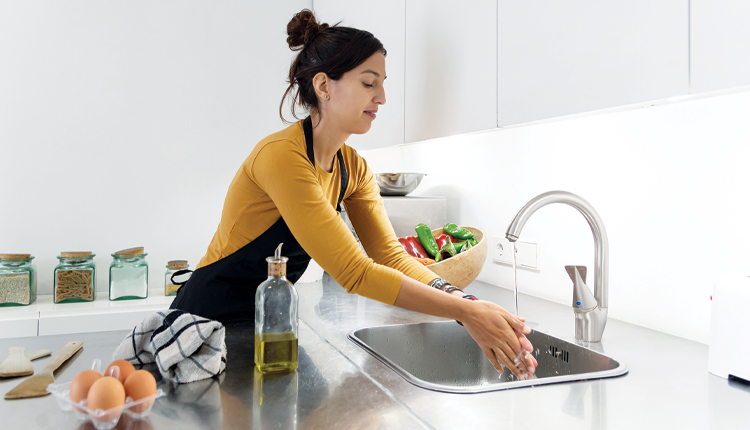

Kansas State University food safety specialists have recommended certain tips to prevent cross contamination in the kitchen:
Wash your hands; don’t just splash and dash. The most important habit in the kitchen is proper and frequent hand washing which is often not up to par. Wash them as soon as you get into the kitchen and you must do so with soap and water, not just splash and dash. You also have to think about where the potential for contamination lies and also wash them when handling fresh produce or raw foods such as meat or eggs. The Academy of Nutrition and Dietetics estimates that proper hand washing may eliminate nearly half the cases of foodborne illness and significantly reduce the spread of the common cold and flu. Use warm water to wet hands, scrub with soap and water for 20 seconds, rinse well with warm water, and air dry or use single-use towels to dry hands.
Wash your cloth towels. Research has identified cloth towels as the most common contaminated surface, and a major reason was simply how often they were handled.Refrain from using the same cloth towel for every task in the kitchen. Instead, use a paper towel for drying hands or to wipe something off the counter. Cloth towels also should be washed frequently. Change out their towels every day or even after every meal prepared with raw meat and poultry.
Avoid sponges but, if you must, use proper sanitising methods. If you insist on having a dish sponge to wipe down counters and cabinets, you should frequently sanitise it to kill and prevent the spread of pathogens that use a sponge’s humid environment to thrive. It can be done in multiple ways, such as putting the sponge in the dishwasher or soaking it in a weak bleach solution. You can place the damp sponge in his microwave and zap it for 30 seconds.
Separate duties of commonly used items. The spread of foodborne pathogens centers on contact with contaminated sources. As food is stored and prepared, separate ready-to-eat foods, such as fresh fruits and vegetables, from raw meat and poultry. This includes separating tools or surfaces used in preparation, including items such as dish towels, cutting boards and other contact surfaces. Separate cutting boards by colour by assigning a different colour to those used with raw meats and those used with fresh fruits and vegetables. Separate cloth towels by usage, one for hand-washing and the other for drying dishes.
Use a food thermometer. Most foodborne pathogens die when a food is cooked properly, which is why some ready-to-eat foods such as salads pose such a high risk for making people sick. The only way to know food has been cooked well enough to destroy any potential microorganisms is to go by temperature. Cook poultry to 165 degrees F.
Comments are closed.